


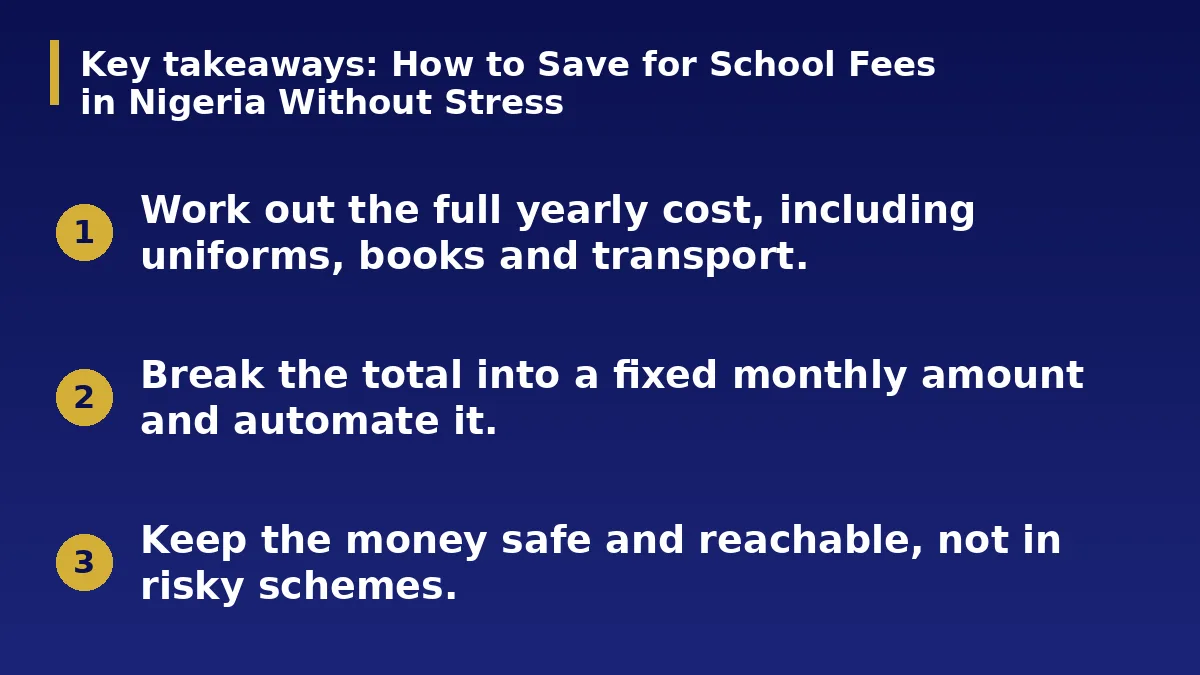
- Work out the full yearly cost, including uniforms, books and transport.
- Break the total into a fixed monthly amount and automate it.
- Keep the money safe and reachable, not in risky schemes.
The Short Answer
School fees arrive on a fixed date, which makes them one of the easiest big costs to plan for. If you divide the cost over the months you have, a large bill becomes a manageable monthly habit. The earlier you start, the smaller each payment.
Know the Full Cost
List everything: tuition, levies, uniforms, books, lesson fees, transport, exams and feeding. Ask the school for the fee schedule and when each part is due. Add a buffer of about ten percent for price changes.
If you have more than one child, make a separate line for each so nothing is missed.
Turn It Into a Monthly Amount
Divide the total by the months left before payment. If the yearly cost is 600,000 naira and you start six months ahead, you need 100,000 a month. If that is too high, increase your timeline or look for extra income.
Treat the amount like a bill and pay it on payday, before other spending.
Where to Keep the Money
Use a separate savings account at a licensed bank, or a regulated low-risk option, so the money stays safe and available when the term starts. Avoid schemes that promise very high returns, as losing school money is painful.
Some schools allow instalments. Ask early, and get any plan in writing.
Lower the Pressure
Compare options, share books or buy second-hand where suitable, and check for scholarships or support programmes. Involve your family in the plan so everyone knows the target.
Keep a record of payments and receipts for each term, and review the plan every year as fees change.
A Worked Example
Suppose the total for next term is 450,000 naira and you have five months to prepare. You need 90,000 naira a month. If you also want a ten percent buffer for fee changes, add 45,000 to the total and the monthly amount becomes 99,000.
If that is too much, extend your timeline to the following term, or look for ways to raise income, such as a side service or selling unused items. Having the numbers makes every choice clearer.
Saving With Other Parents or Family
Some families pool support, with relatives agreeing in advance to contribute a fixed amount each month towards a child fees. Write down who gives what and when so there is no confusion.
If you join a savings group or cooperative, check that it is properly registered, that records are kept and that withdrawals are transparent. Avoid any group that cannot show where the money is held.
Plan for the Long Term
School costs rise as children move up, so plan beyond the current term. Consider a regular savings habit for future years, and review your plan at the start of each school year.
If you can, build the school budget into your overall monthly plan instead of treating it as an emergency. Planned costs rarely feel heavy, while unplanned ones often lead to borrowing.
Action Checklist
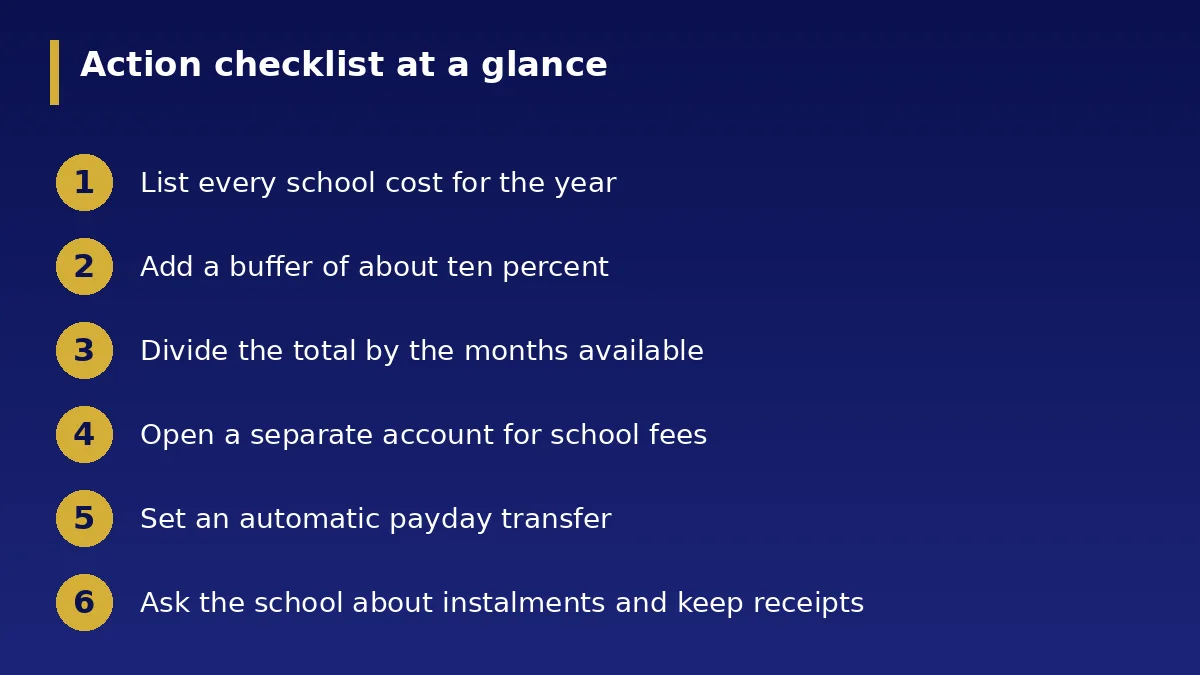
- List every school cost for the year
- Add a buffer of about ten percent
- Divide the total by the months available
- Open a separate account for school fees
- Set an automatic payday transfer
- Ask the school about instalments and keep receipts